Heated bathroom floor under tile: who does each part, and when it is tested
How a heated bathroom floor goes in under tile in Ontario: what the tile setter and the electrician each do, when ESA inspects, and the three readings to keep.
Bathroom Renovations · October 27, 2026 · 8 min read
A heated bathroom floor under tile is a thin electric mat or loose cable set in the mortar under the tile, run by a thermostat on the wall with a sensor in the floor. In Ontario the job is split between two trades. The person who lays the tile can lay the mat, but the circuit from the panel belongs to a Licensed Electrical Contractor, and the mat has to be inspected before anything covers it.
That split is why so many heated floors go wrong. Each trade does its part well and nobody checks the hand-off between them. Below is how the work is divided, the order it happens in on site, and the three readings that prove the mat survived each stage.
Who may do which part of the job in Ontario?
The Electrical Safety Authority says almost anyone may lay the heating mat or cable, up to the first junction box where its cold lead is connected. Wiring from the panel to that box and the thermostat is done by a Licensed Electrical Contractor. A notification of work is filed with ESA, and the mat is inspected before it is covered.
That comes from ESA Flash 25-08-FL on electric in-floor heating, published in May 2025. A homeowner may legally run the circuit in their own house, and ESA says plainly that it does not recommend it.
Part of the job
Who does it
What ESA's notice adds
New circuit from the panel, wall box for the thermostat
Licensed Electrical Contractor
Branch circuit wiring is the electrician's work, not the flooring installer's
Laying the mat or cable on the subfloor
Tile setter or flooring installer, or the electrician
Allowed up to the first junction box for the cold lead
Notification and inspection
Filed with ESA, usually by the electrician
Required for the heating mat too, and done before it is covered
Thermostat and floor sensor connection
Licensed Electrical Contractor
Whoever connects the thermostat makes sure the sensor is in and connected
The mat and thermostat themselves
Chosen before the floor is opened
Both must carry a recognized Canadian approval mark such as CSA
What has to be settled before the mat goes down?
The heated area, the thermostat spot and the floor build-up. The mat is sized to open floor, not the whole room, so the toilet, the tub and any cabinet that sits on the floor are drawn out of the plan first. The thermostat box and the path of the cold lead to it are fixed while the wall is still open.
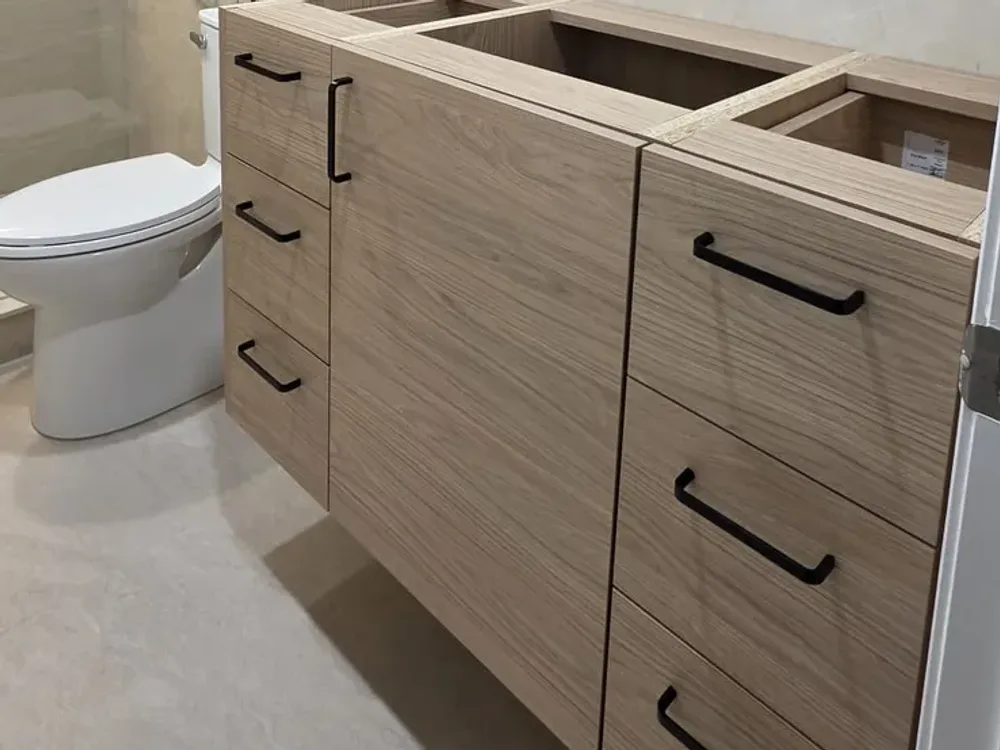
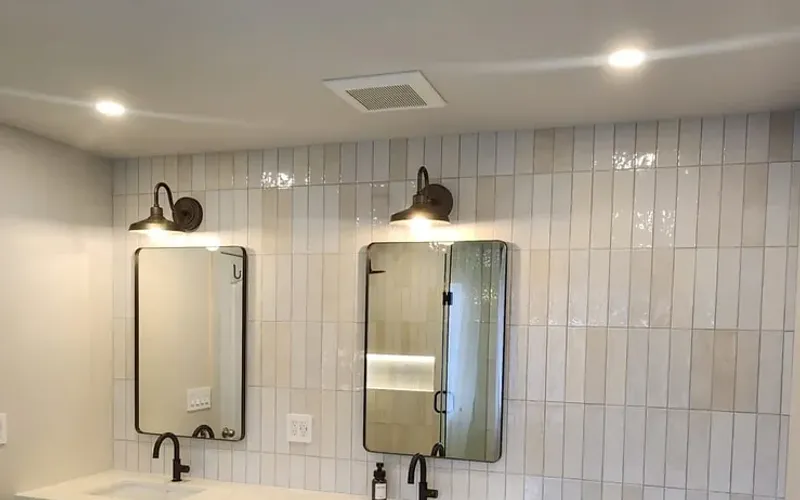
One of our bathrooms before the vanity top went on. The toilet sits on the floor; the vanity hangs on the wall and leaves the tile under it open.
A room like the one in the photo shows why the plan comes first. The patch under the toilet is never heated, because the toilet is bolted through the floor there. The floor under a wall-hung vanity is open, so whether the mat runs under it is a choice to make on paper, not on the day the tile setter arrives. A vanity that stands on the floor is simply left out.
Wood subfloor or concrete slab
Over a wood subfloor the mat goes onto a flat, solid surface with every staple and nail head removed, since a sharp point under the cable can cut it when the tile is pressed down. Over a concrete slab, which is what most basement bathrooms sit on, the makers we read call for an insulating board under the mat, or much of the heat goes down into the concrete. That board adds height, so it is counted in before the door and the shower curb are set.
The mat also sits under the uncoupling or waterproofing layer, or inside it, depending on the system. That order comes from the membrane maker's instructions and is decided together with the rest of the bathroom waterproofing, never improvised on the floor.
In what order does the work happen on site?
Electrician first, floor prep second, mat third, inspection fourth, tile fifth, electrician again last. Each switch between trades is a point where the mat can be damaged without anyone noticing, so a resistance reading is taken at three of them.
1Rough-in, by the electricianThe new circuit is pulled from the panel and the wall box for the thermostat goes in. The electrician files the notification with ESA.
2Floor preparationThe subfloor is cleaned and flattened, insulating board goes down on a slab, and the membrane goes in where the system puts it under the mat.
3First reading, straight out of the boxBefore the mat is unrolled, its resistance is measured and compared with its label. A mat that fails here goes back unopened.
4Mat laid, sensor placedThe mat is fixed down, its mesh cut to turn corners while the cable itself is never cut. The floor sensor goes between two runs of cable, not across them.
5Second reading, then the ESA inspectionThe mat is measured again where it lies, photographed, and inspected while it is still bare.
6Tile set over the matThe tile setter beds the cable in mortar or a levelling compound and sets the tile, working with a plastic trowel near the cable.
7Third reading, through the finished tileMeasured once more at the cold leads, before anything is connected.
8Thermostat connected, by the electricianThe cold leads and the sensor are wired to the thermostat. The floor stays off until the setting material has cured.
What do the three resistance readings show?
Whether the cable is still whole. Every mat has a resistance range printed on its label in ohms. If a reading drifts outside that range, or the cable reads as touching its ground shield, it was damaged at the step just before. Found at the second reading, that is a new mat; found after tiling, it is a new floor.
The label in ESA's notice is a good example of what to look for: a range of 52 to 65 ohms, 120 VAC and 2.0 A. WarmlyYours, one of the mat makers, accepts readings within 15% of the label value and asks for all three to be written down; its installation guide for mats under tile walks through the meter setting. Other makers use their own tolerance, which is printed in the instructions that come with the mat.
Reading 1: in the box
Shows the mat arrived whole. Compared with the label range.
Reading 2: laid, before cover
Catches a nick from a staple, a knife or a boot. Compared with the label and with reading 1.
Reading 3: under the tile
Catches damage from the trowel or the tile itself. Taken before the thermostat is wired.
With every reading
A check from the cable to its ground shield, which should show no connection at all.
Keep the sheet with the readings, the mat's label and the photos of the laid mat with the rest of the house papers. Whoever opens that floor in ten years will know where the cable runs without guessing.
Why does the voltage on the label matter so much?
Because the thermostat passes on whatever voltage it is fed. Many floor thermostats accept both 120 V and 240 V, and the mat does not. A mat made for 120 V on a 240 V supply runs far hotter than it was built for, and a missing floor sensor removes the one thing that would have cut it off.
That is exactly the case ESA describes in its notice. In a home bathroom, a 120 V mat had been connected to 240 V and the floor sensor was never installed, with no notification of work filed. The floor reached 62.2 C, and an elderly man who fell on it died weeks later of his burns. Before the power is turned on, these should all be true:
The voltage on the mat's label matches the supply the electrician brought to the thermostat.
The total current of the mats on that thermostat is within what the thermostat is rated for.
The floor sensor is in the floor and connected, not coiled up in the wall box.
The mat and the thermostat both carry a CSA or other recognized Canadian approval mark.
The ESA inspection of the bare mat happened, and the notification number is on the paperwork.
Some installers also leave a second sensor in the floor, unconnected, beside the first. If the working one ever fails, the spare is wired in at the thermostat and no tile comes up.
Can the heat go into the shower floor?
Only where the mat's maker lists it for a wet area and the shower's waterproofing system allows it. Many mats are for dry floor only. Where heat does go into a shower, the mat sits in the exact layer the membrane maker names, because the membrane has to stay unbroken above it.
In most of the bathrooms we build, the heat stops at the shower curb or the edge of a curbless shower, which is where people step out with wet feet anyway. In a small room the layout decides how much open floor there is to heat at all, and our article on small bathroom layouts that work shows how quickly fixtures take it up.
How long before the floor can be switched on?
Not until the mortar or levelling compound over the cable has cured, which is a figure set by that product's maker. WarmlyYours puts the wait at 7 to 28 days depending on the setting material. Heating it sooner can leave the mortar brittle and the tile poorly bonded.
The first time the floor is used is the moment to look at the thermostat screen: it should read a floor temperature, which is the sign the sensor is connected and doing its job.
A heated floor as part of the bathroom
Art Style Construction renovates bathrooms across Toronto and the GTA, and on our jobs the electrician, the tile setter and the inspection are booked as one sequence, so the floor is never covered between them. Our bathroom renovation page shows how the whole room comes together, and the tile itself is covered on our tiling and backsplash installation page. If you are planning a warm floor, send us a message about the room.
Questions homeowners ask about this
Do you need an ESA permit for a heated bathroom floor in Ontario?
Yes. ESA says a notification of work has to be filed for in-floor heating, including the mat laid by a flooring installer, and the mat has to be inspected before it is covered. The electrician who runs the circuit usually files it.
Can a tile setter install the heating mat?
Yes, up to the first junction box where the mat's cold lead is connected. The circuit from the panel and the thermostat connection are done by a Licensed Electrical Contractor, and the mat still has to be inspected before the tile goes on.
Why is the heating mat tested with a meter three times?
To find damage at the step that caused it: once out of the box, once laid before it is covered, and once after the tile is set. Each reading is compared with the resistance range printed on the mat's label.
How long after tiling can you turn on floor heating?
Only after the mortar or levelling compound over the cable has cured, which its maker sets. One mat maker gives 7 to 28 days depending on the material. Turning it on sooner can weaken the tile bond.