Plaster feature wall: what goes into the wall before the first coat
Before a plaster feature wall is troweled: TV backing, outlets, LED channels, the drywall level, primer and a sample board, in the order a Toronto crew works.
Home Renovations · October 30, 2026 · 8 min read
Before a plaster feature wall gets its first troweled coat, everything that will sit in or on that wall has to be in place: the wood backing for a TV mount, every outlet and cable box, the channel for any LED strip, the grilles and the trim. The drywall under it has to be flat and primed with something the plaster can grip. A troweled finish is built from thin, overlapping passes across the whole wall, so a hole cut later or a patch made later shows as exactly that.
The plaster itself is the last few days of the job. Most of what decides how the wall looks happens before anyone opens a bucket, and it takes the framer, the electrician, the drywall finisher and the plasterer working in the right order. Below is the wall layer by layer, what has to be settled before the finish, and how we use a sample board to check colour and sheen in the room's own light.
What is inside a plaster feature wall, from the studs out?
Six layers, and each one belongs to somebody. On a TV wall the first two do most of the work and nobody sees them once the room is done.
1. Studs and backingFramer or carpenter
Solid wood blocking between the studs wherever a TV mount, a floating shelf or a heavy mirror will bolt on.
2. Boxes, cables and channelsElectrician and low-voltage installer
Outlet and switch boxes, a recessed box behind the TV, a pass-through for the HDMI cables, and the feed for any LED strip.
3. Drywall, taped and sandedDrywall finisher
Joints taped and coated, screws covered, sanded flat. Skimmed over the whole sheet when the wall will be lit from the side.
4. Primer with toothPlasterer or painter
A water-based primer with grit mixed in, left to dry right through, so the plaster grips and dries at an even rate.
5. Plaster coatsPlasterer
Two or more thin troweled coats. The last one is pressed hard with a clean trowel when the finish calls for a sheen.
6. Protective coatPlasterer
Wax or a sealer picked for the room. A hallway wall gets touched far more often than a bedroom wall.
The order is the point. Nothing in the first two layers can change after the fifth goes on without cutting into the finish.
What does a wall look like when it is ready for the finish?
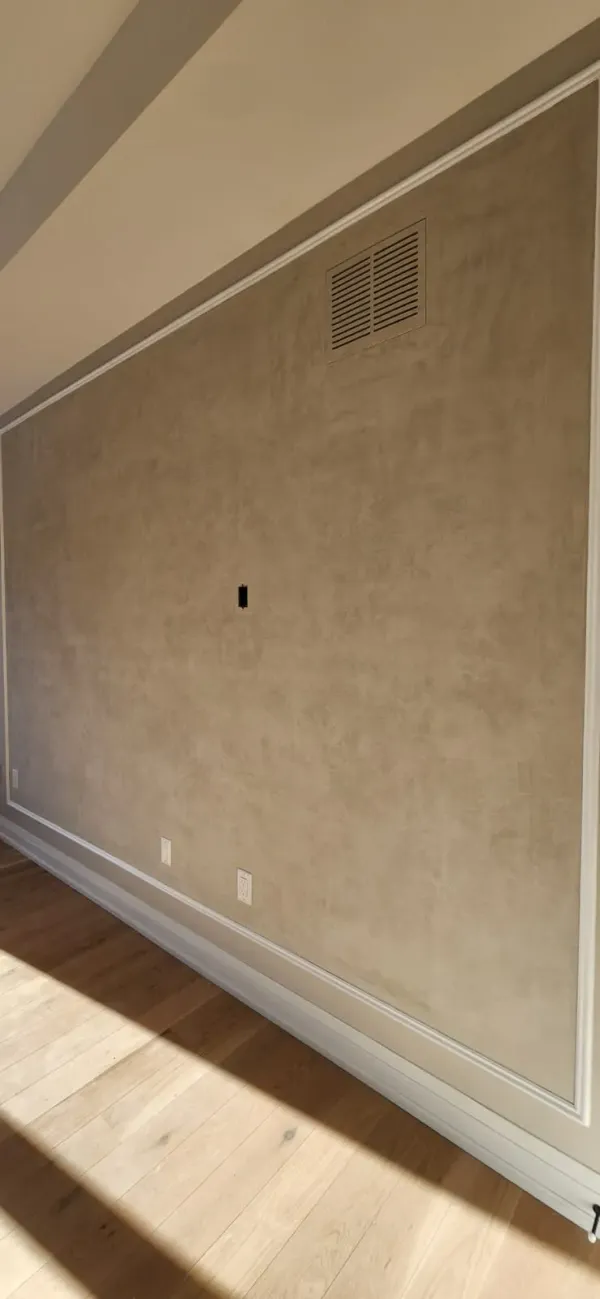
A plaster panel inside moulding in one of our living rooms.
This is a beige troweled panel framed in moulding. Look at what was placed before the plaster went on.
One opening at TV height for the cables, which the screen will cover.
Two outlets low on the wall, both inside the frame.
A return-air grille near the top, so the plaster stops neatly at its edge.
The moulding frame, fixed and caulked, giving the panel a clean line to finish against.
Every one of those was decided while the wall was still bare drywall. Moving any of them now means cutting the finished panel, and the repair would sit right in the middle of the frame where the eye goes first.
What has to be decided before the plaster goes on?
The TV, the power, the lights and the trim. On a TV wall, settle the screen size and the mounting height first, because the blocking, the recessed box and the outlets all follow from that one decision.
In or on the wall
Settled
What happens if it is late
TV mount position and the blocking behind it
Before the drywall goes up
The mount goes into drywall alone, or the finished wall is opened to add wood behind it
Recessed box and cable path behind the TV
Before the drywall goes up
Cables hang below the screen, or a channel is cut through the plaster
Outlets, switches and the LED feed
At the electrician's rough-in
New boxes are cut into the finish, and the cut edges never match the trowel marks around them
Channels or aluminium profiles for LED strips
During drywall finishing
A strip stuck on afterwards shows its glue line and lights up every ridge
Grilles, thermostat, alarm keypad
During drywall finishing
The plaster is worked around a device already in place, or the device moves later and leaves a scar
Moulding frames and baseboard
Before the plaster, then masked
Trim added later meets the plaster at a joint that gets caulked over a finished surface
Colour and finish, on a sample board
Before the material is ordered
The colour is picked from a fan deck under store lights and reads differently in the room
Our carpenters set the blocking and any shelving on the same wall, the way they do for our custom built-ins and shelving, so the backing is where the mount will actually land.
Does the drywall need a Level 5 finish under plaster?
Not always. Level 4 means the joints and screws are taped, coated and sanded smooth. Level 5 adds a thin skim of compound over the whole sheet, so the paper face and the taped joints absorb the same way and look alike in hard light. A drywall contractor explains the difference in this JLC answer on Level 5 drywall versus veneer plaster.
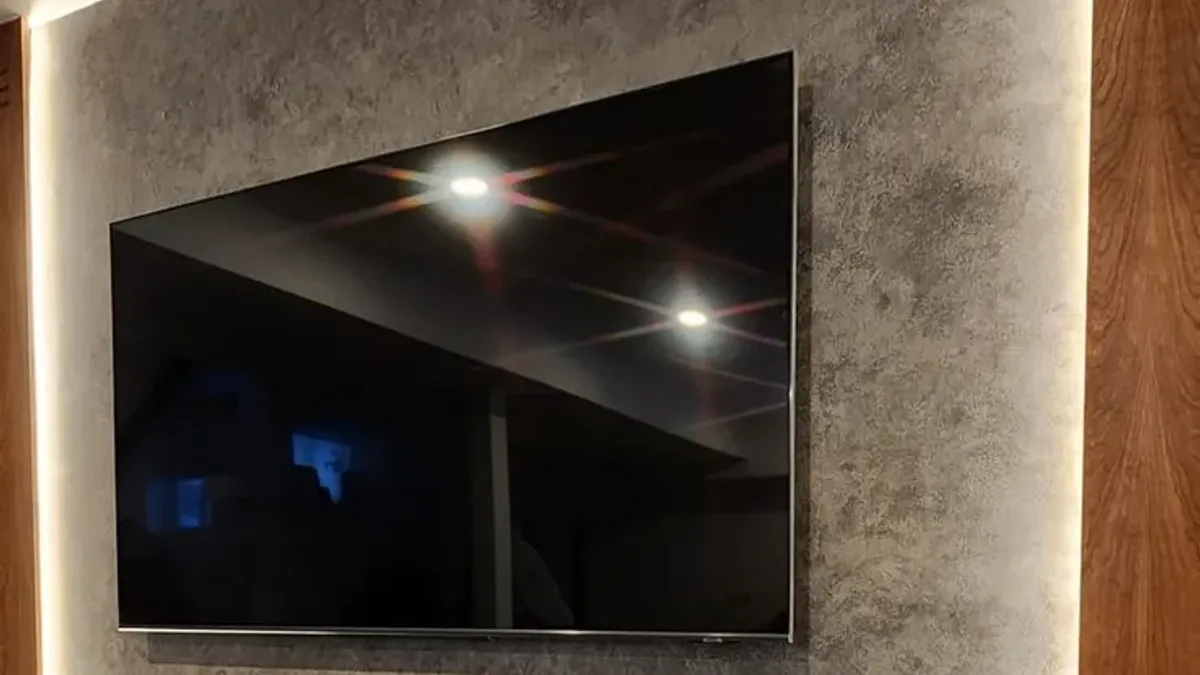
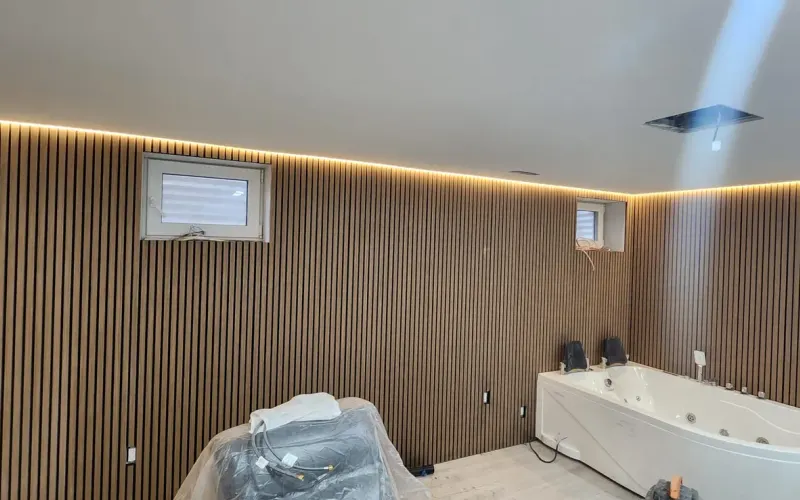
An LED strip along the edge of a feature wall, like the one on the TV wall at the top of this page, throws light almost flat across the surface. Light at that angle picks out every ridge, joint and screw dimple, and a plaster coat a millimetre or two thick follows whatever is under it. When a wall will be lit that way, we skim the whole surface before priming. A wall lit straight on by a ceiling fixture is far more forgiving. Where lights go and what they do to a finish is covered in our post on layering and placing renovation lighting.
Plaster over a wall that is already painted
Sound paint can take plaster. Peeling or chalky paint is scraped back first, a glossy coat is scuffed, and the gritted primer goes over all of it. Heavy texture, such as a knockdown pattern carried down from the ceiling, is skimmed flat before anything else, because a thin plaster coat shows the texture right through.
Why are the boxes cut before the finish coats?
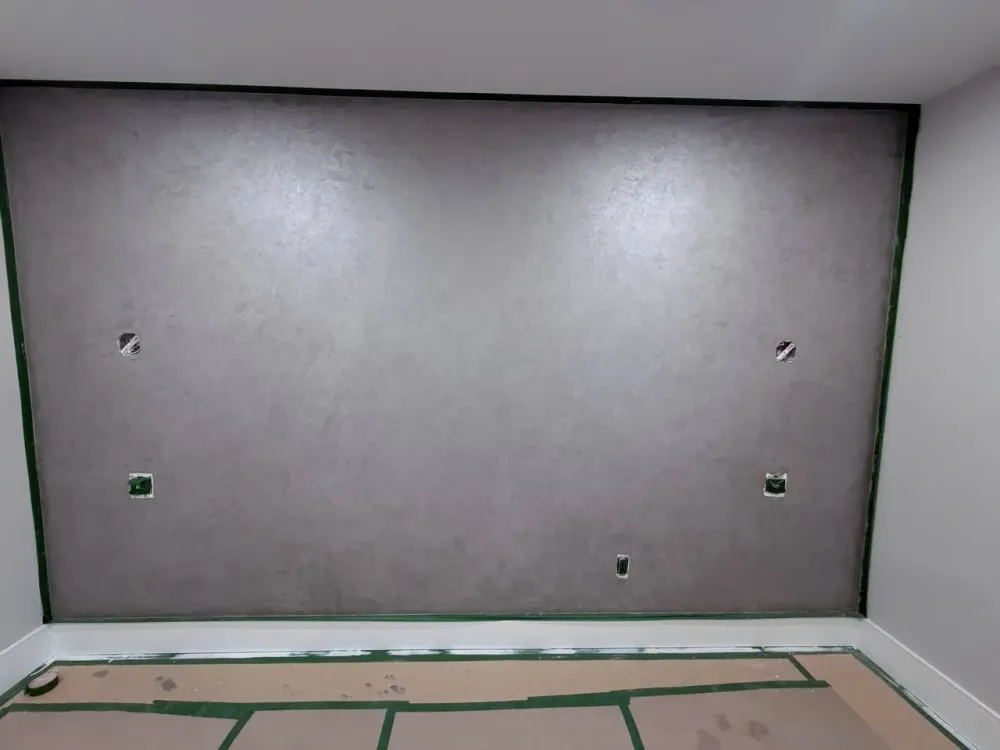
A grey plaster wall in a basement room, five boxes set and cut out before the last coat.
So the plates sit flat on finished plaster and cover a clean edge. In this basement room the electrician set two round boxes high on the wall, two square ones lower down and one near the floor. The plasterer worked up to each box and kept its edge taped. Covers and plates go on after the protective coat.
The green tape along the ceiling, the side walls and the baseboard does the same job around the outside. The plaster stops on the straight line the tape sets instead of feathering onto the next surface. The drywall under this wall was hung and finished by the same crew that does our drywall installation and repair, so the base was planned with the finish in mind.
How do you judge a plaster colour before the wall is done?
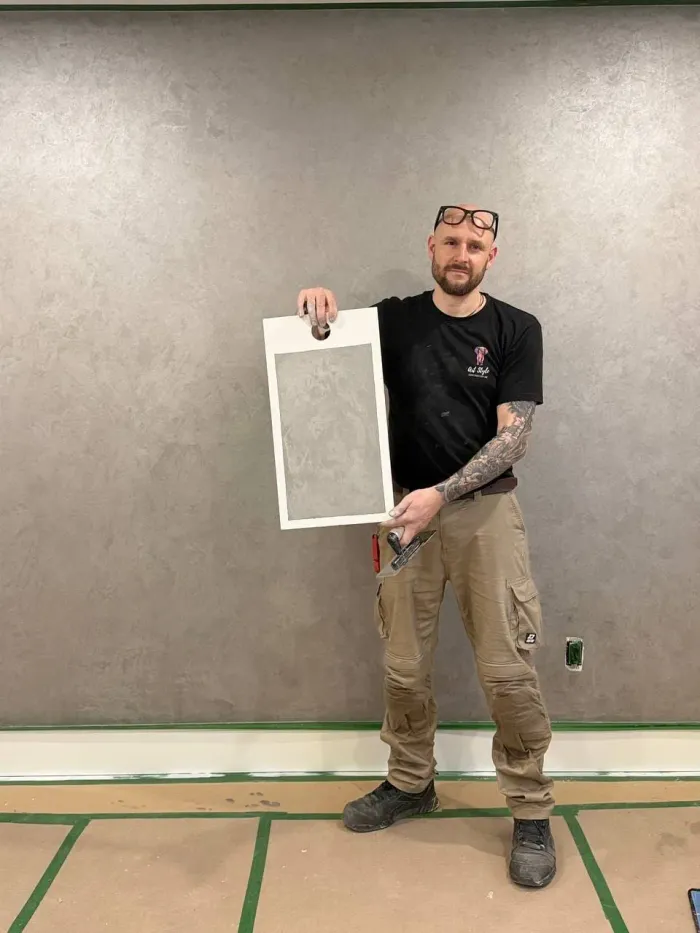
On a sample board, in the room. For a plaster or special finish we make a sample board first and hold it against your wall in that room's light, as on every painting and plaster job we do. A troweled finish moves with the light. The same grey reads warmer under a yellow bulb and flatter on a cloudy afternoon, and the trowel marks that look soft at noon can look busy under a spotlight.
When the board is up, these are the things to look at:
The sample board, held up against the wall it was made for.
Look at the board in daylight, then again at night with only the room's own lights on.
Hold it where the LED strip or the main fixture will hit the wall, not in the middle of the room.
Check the sheen from where you sit. A pressed, shiny finish across from a window throws glare, and so does one across from a TV that is on.
Put it next to the floor and any wood, stone or tile on the same wall.
Keep the board once you approve it. The finished wall is checked against it.
What should not be done to the wall once it is finished?
Drilling. Any hole added after the finish needs a repair in a surface that cannot be blended in one spot, because the trowel pattern and the pressed sheen run across the whole wall. A small scuff often buffs out, or takes a touch of wax. A hole does not. That is why the mount, the boxes and the hooks come first.
If you want art or a mirror on a plaster wall later, a picture rail on the ceiling or a hanging system on the trim leaves the plaster alone. TV and fixture installs on walls that are already finished are part of our handyman services, and on our own feature walls they go onto the backing that was set for them.
Day to day, a soft dry or barely damp cloth is all the wall needs. Skip abrasive cleaners. A wall that gets bumped a lot, like a hallway or the side of a staircase, is better sealed than waxed, and that is settled at the sample board, together with the colour.
Questions homeowners ask about this
Can decorative plaster go straight onto new drywall?
Yes, once the joints are taped and sanded and the wall is primed with a primer that has grit in it, left to dry fully. If the wall will be lit from the side by an LED strip, we skim the whole surface first so the joints do not show through.
Can you mount a TV on a plaster feature wall?
Yes, when the wood backing and the cable box were put in before the plaster. The mount bolts through the finish into the backing, and the cables run inside the wall to a box behind the screen.
Can a damaged spot in troweled plaster be repaired?
A light scuff often buffs out or takes a touch of wax. A hole or a gouge can be filled, but the patch rarely matches the trowel pattern around it, which is why openings are planned before the finish.
Does decorative plaster work in a bathroom?
On the dry walls of a bathroom, over primed drywall, yes. Inside a shower it is a different build on cement board with a waterproof membrane, planned together with the rest of the bathroom waterproofing.