
Structure
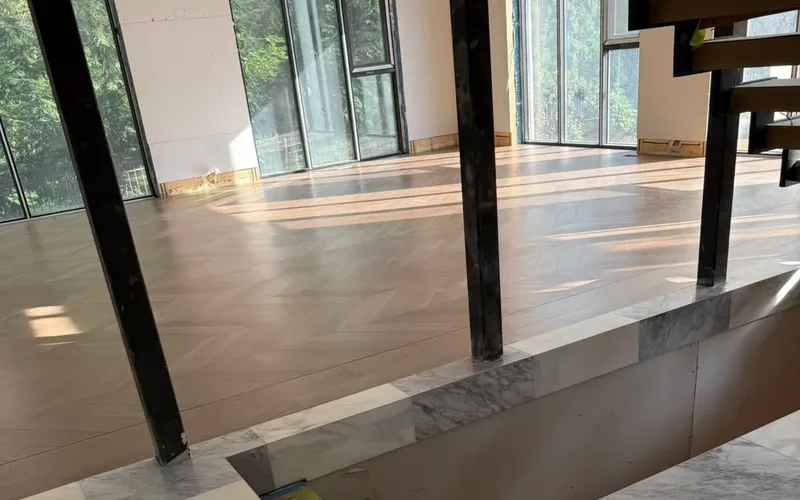
Load-Bearing Walls: How to Know Before You Plan to Remove One
How to tell if a wall is load-bearing before a Toronto renovation: joist direction, the bearing line, who decides, permits and what replaces the wall.
Read the guide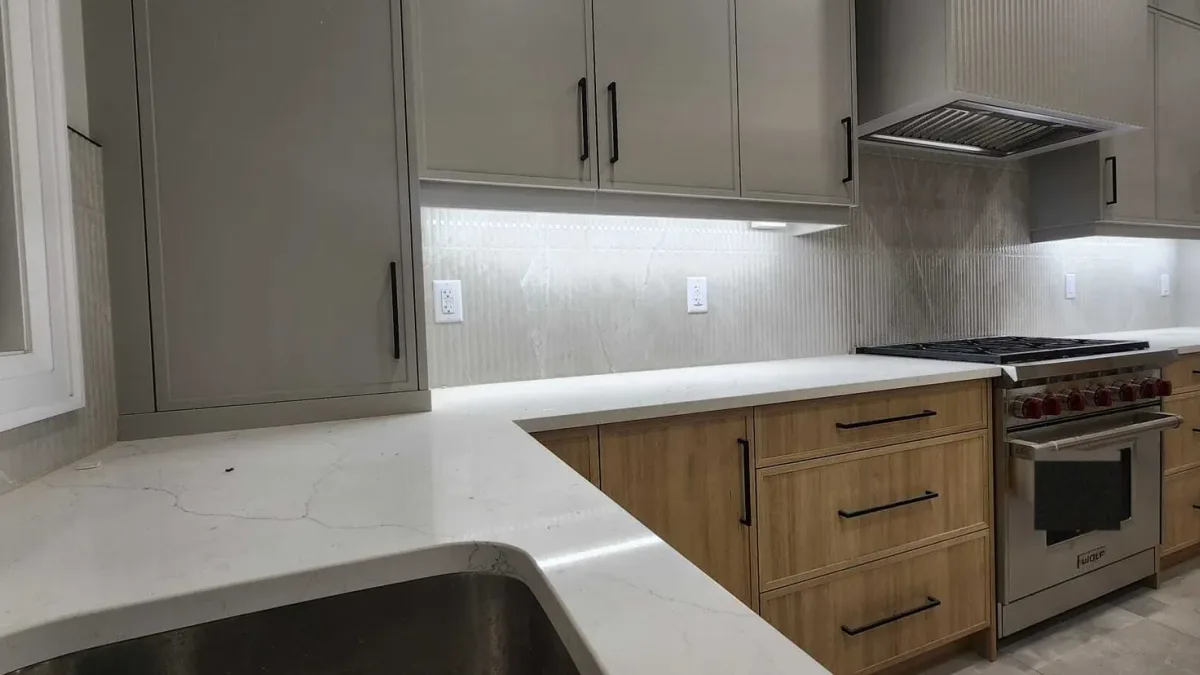
Plywood, MDF or particleboard cabinet boxes for a Toronto kitchen: how each one holds screws, handles water and takes an edge, and where it belongs.
Kitchens · September 19, 2026 · 8 min read
Two kitchens can look identical on installation day and be nothing alike five years later. The difference is rarely the door style anyone agonised over in the showroom — it is what the boxes behind the doors are made of. Cabinet materials come down to three in most Toronto kitchens: plywood, MDF and particleboard. Each one is good at something, and each one fails in a different way.
None of the three is a bad material. Particleboard in a dry upper cabinet with properly sealed edges will outlast the kitchen it was installed in. Plywood under a sink with a slow supply leak will still swell, delaminate and go soft. What decides the outcome is where each material is used, how its edges are sealed, and what the box is hanging on. Here is how the three actually behave, and how to read which one you are being quoted.
A cabinet is two separate decisions, not one. The box — sides, bottom, back and shelves — is usually plywood or particleboard. The door and drawer front is a different material again, most often MDF when it is painted and a veneered panel when it is wood-look. Almost every kitchen mixes them.
That matters because "solid wood cabinets" is a phrase that describes almost nothing built today. In a well-made kitchen, solid wood appears in the door frames, the drawer box sides and occasionally a visible end panel. The flat panels are sheet goods, and they should be: a solid wood panel 600 mm wide moves across the grain with the seasons, and a cabinet box has to stay square. The useful question is not whether there is real wood in it, but which sheet material is in which part. A quote that lists the box, the door and the drawer box separately is a quote you can actually compare, which is the same discipline as reading a good contractor quote against a bad one.
Plywood is layers of veneer glued in alternating directions. MDF is wood fibre compressed with resin into a uniform slab. Particleboard is wood chips and resin, coarser inside than MDF. Plywood is the lightest and holds screws best, MDF machines and paints best, particleboard is the flattest and the least expensive of the three.
| Property | Plywood | MDF | Particleboard |
|---|---|---|---|
| What it is | Thin veneers cross-laminated in odd-numbered layers | Fine wood fibre and resin, pressed to a uniform density | Wood chips and resin, denser at the faces than the core |
| Weight of a full sheet | Lightest — matters for tall uppers and for what the wall has to carry | Heaviest per sheet — a large MDF door needs hinges rated for it | Heavy, between the other two |
| Holding a hinge or a screw | Best. Cross-grain layers grip the thread and resist pull-out | Good into a face, poor into a cut edge unless an insert is used | Weakest. A screw driven twice into the same hole usually stops holding |
| Contact with water | Swells and can delaminate, but often dries and stays usable | Swells irreversibly at an unsealed edge and stays swollen | Swells fastest and crumbles. The failure is permanent |
| Flatness across a wide panel | Can cup or bow slightly; voids in cheap cores show as dips | Very flat and void-free all the way through | Very flat, which is why factory melamine boxes use it |
| Taking paint | Grain telegraphs through unless it is filled and primed first | No grain, no movement — the reason painted doors are MDF | Not painted directly; it arrives faced in melamine or laminate |
| Where it earns its place | Sink and dishwasher bases, tall pantries, anything carrying weight | Painted doors, drawer fronts, mouldings, shaker profiles | Dry boxes: uppers, pantry interiors, closet and laundry millwork |
One line in that table does most of the work. Plywood holds fasteners because its grain runs in alternating directions, so a screw crosses several layers instead of pulling apart one loose mat of chips. That is why a hinge plate, a drawer slide, or a heavy pull-out is a plywood question rather than a style question.
Because it has no grain and almost no seasonal movement. A painted solid-wood door is made of stiles and rails joined at four corners, and those joints open and close slightly as indoor humidity swings. The paint film cannot stretch, so a hairline appears along each joint. MDF is one continuous slab, so there is no joint to open.
Toronto makes this worse than most climates. Indoor relative humidity here swings from high summer levels down to very dry air in January once the heating runs, and wood moves with it every single year. On a stained wood door, a hairline at the joint reads as character. On a white or deep-colour painted door it reads as a crack, and it comes back after every touch-up because the cause is movement, not the paint.
MDF pays for that stability in two ways. It is heavier, so wide doors need hinges rated for the weight or they sag. And a cut edge is thirsty: an MDF door has to be sealed and primed on every face and edge, including the bottom edge nobody looks at, which is exactly where an under-sink door picks up water.
They fail differently. Plywood swells at the edge and may delaminate, but it often dries out and keeps working. MDF drinks water into its cut edge, swells like a sponge and stays swollen once it dries. Particleboard swells fastest and loses its structure — the chips separate and the panel goes soft.
Almost all of this comes through an edge, not a face. Faces are sealed with melamine, veneer, laminate or paint; the vulnerable part is anywhere the panel was cut and the cut was not covered. The recurring failures in a kitchen are predictable:
That is why the sink base deserves plywood even in a kitchen where everything else is particleboard, and why the drip tray or waterproof mat under the sink is not an accessory. In a bathroom the same logic applies with more force, because the humidity never goes away — we cover the wet-area side of it in bathroom waterproofing, and it shapes how we build vanities on bathroom renovations.
No. Once the material is sensible for its position, the things that decide how a kitchen ages are the edge treatment, how the box is joined, what the hinges and slides are, and how the boxes are fixed to the wall. A plywood box with a raw edge and stapled joints will disappoint before a particleboard box built properly.
These are the details worth asking about, in roughly the order they cause trouble:
Look at a cut edge and lift the door. Plywood shows visible layers on an unfinished edge. MDF shows a smooth, uniform brown edge with no texture. Particleboard shows visible chips and flakes. If everything is already banded, the shelf pin holes and the weight tell you almost as much.
| What to check | Plywood | MDF | Particleboard |
|---|---|---|---|
| An unbanded cut edge | Distinct stripes — you can count the plies | Smooth and even, like dense cardboard | Obvious chips and flakes of different sizes |
| Inside a shelf pin hole | Layered, sometimes with a small void | Clean, uniform, dust like fine powder | Coarse and crumbly at the rim |
| Lifting one door off its hinges | Noticeably light for its size | Dead weight — heavier than it looks | Heavy, and sounds dull when tapped |
| The quote wording | Named by species and grade, and by thickness | Usually named plainly, because it is the correct choice for a door | Often appears as "furniture board", "engineered panel" or just "melamine" |
| Panel thickness | Box sides commonly around 16 to 19 mm | Doors commonly 18 to 19 mm | Thin sides and a thin back are the real economy, not the material |
A note on the word "melamine". It is not a core material — it is the resin-saturated paper face pressed onto one. The board underneath is almost always particleboard and occasionally MDF, so "melamine boxes" tells you how the surface is finished and nothing about what is under it. Ask what the substrate is.
Position by position, rather than one material for the whole kitchen. Wet and load-bearing positions get plywood. Painted fronts get MDF. Dry boxes, closets and laundry millwork are fine in faced particleboard. Most sensible kitchens use all three, deliberately.
| Where | Sensible choice | Why |
|---|---|---|
| Sink base and dishwasher run | Plywood box, sealed edges, a tray in the bottom | The only place in the kitchen where water is routine rather than accidental |
| Upper cabinets | Faced particleboard is fine; plywood if the run is tall or heavy | Dry position. What matters more is how the box is fixed to the studs |
| Tall pantry with pull-outs | Plywood sides | Loaded pull-outs put repeated leverage on slide screws |
| Painted doors and drawer fronts | MDF, sealed on all six faces | No grain and no joint means no hairline crack when the air dries out in January |
| Bathroom vanity | Plywood box, sealed MDF or veneered fronts | Constant humidity, splashing, and a supply connection inside the box |
| Laundry and mudroom millwork | Faced particleboard, plywood at anything near a washer | Wet coats and boots attack the toe kick before they attack the box |
| Basement built-ins | Either, held off the slab on a sealed base | Below grade, the moisture arrives from the floor and the walls, not from a tap |
| Condominium suite | Lighter boxes, plywood where anything hangs on a hollow partition | Wall build-ups vary by building, and the elevator limits what arrives in one piece |
That last row is a real constraint rather than a detail. In a condo, cabinet boxes have to fit an elevator and a protected corridor route, which sometimes means flat-packed boxes assembled in the suite instead of pre-built ones — one of several things the building decides for you, alongside the rules covered in what a condo board will and will not allow and the way we plan condo and apartment renovations. Built-in shelving and millwork elsewhere in the house follows the same material logic, which is most of what custom carpentry and built-ins involves.
Work through this while the layout is still on paper. Every item changes either the order or the drawings, and all of them are cheaper to change now than after the boxes are built:
Asked in that order, the material question stops being a debate about which one is best and becomes a short specification you can hold a supplier to. None of the three materials will disappoint you in the right place; any of them will in the wrong one. If you are planning a kitchen renovation in Toronto or the GTA, finished work is in the project gallery, and you can get in touch to talk through what the boxes should be.
In some positions, clearly. Plywood holds hinge and drawer-slide screws better because the screw crosses several cross-grained layers, and it survives a slow leak far better than particleboard, which swells and crumbles permanently. That makes it the right call for the sink base, the dishwasher run and tall pantries with loaded pull-outs. For dry upper cabinets, a properly built and fully edge-banded particleboard box performs well, and the money is better spent on hinges, slides and edge banding.
Because MDF has no grain and barely moves with humidity. A painted solid-wood door is built from stiles and rails joined at the corners, and those joints open slightly as indoor air dries out each winter in Toronto. Paint cannot stretch, so a hairline appears along the joint and returns after every touch-up. MDF is one continuous slab with no joint to open. The trade-offs are weight — wide doors need hinges rated for it — and that every edge has to be sealed and primed.
MDF soaks water into an unsealed cut edge, swells like a sponge and stays swollen after it dries. Particleboard swells fastest and loses structure as the chips separate, so the panel goes soft. Plywood swells at the edge and can delaminate, but often dries out and remains usable. Nearly all of this damage arrives through an edge rather than a face, which is why edge banding and a sealed bottom edge on an under-sink door matter more than the core material alone.
Look at any unbanded cut edge and inside a shelf pin hole. Plywood shows visible stripes you can count; MDF is smooth and uniform like dense cardboard; particleboard shows obvious chips and flakes and crumbles at the rim of a hole. Weight helps too — plywood is noticeably light for its size, MDF is dead weight. On a quote, "melamine" describes only the surface paper, not the core, so ask specifically what the substrate underneath it is.
Structure
How to tell if a wall is load-bearing before a Toronto renovation: joist direction, the bearing line, who decides, permits and what replaces the wall.
Read the guide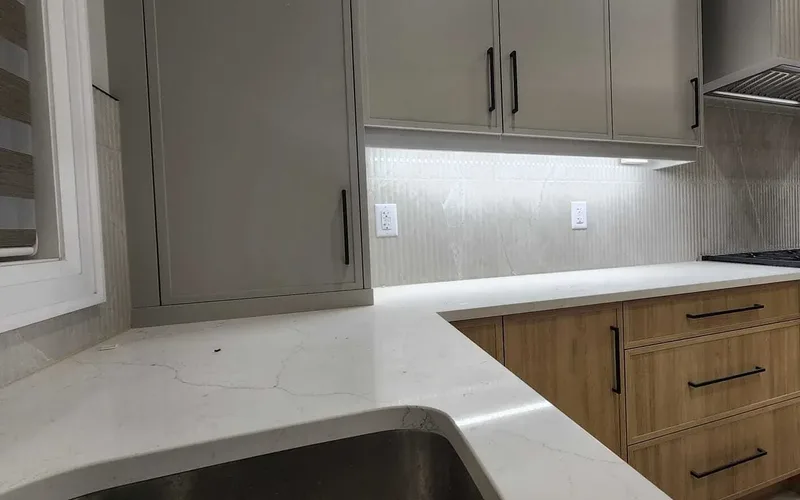
Condos
Condo renovation rules decide what you may change in a Toronto suite: what the board owns, when an alteration agreement is needed, and what gets refused.
Read the guide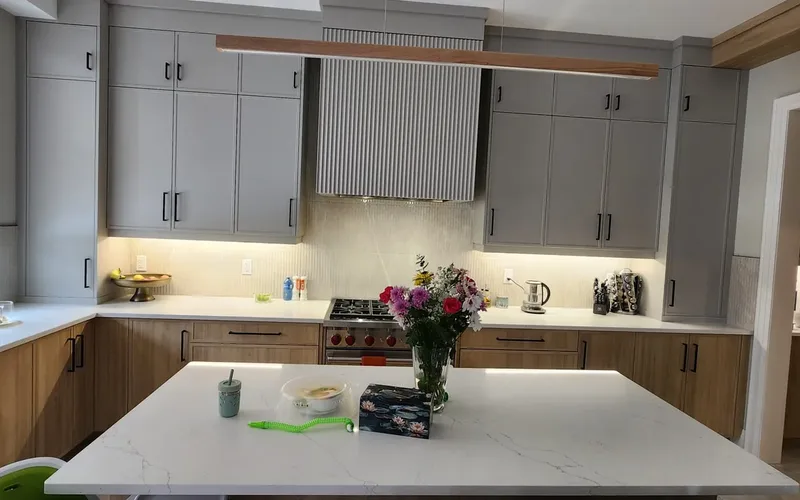
Kitchens
A kitchen layout decides where you stand and what you reach for. How to choose the right one for the way you actually cook in a Toronto or GTA home.
Read the guide
We will walk the space with you, tell you what it actually takes, and put it in writing.