Popcorn ceiling in a Toronto house: test it, then scrape, skim or cover
How a popcorn ceiling in an older Toronto house gets flat: the asbestos test, three questions that pick the route, and what each route does to lights and trim.
Drywall & Ceilings · November 11, 2026 · 7 min read
Before anyone wets, scrapes or sands a popcorn ceiling in an older Toronto house, a sample of it goes to a lab. Nobody can tell by looking whether the texture holds asbestos, and the usual way of taking it down is the very thing that would release the fibres if it does.
When the result is back, three facts pick the route: what the lab found, whether the texture was ever painted, and what the ceiling is made of underneath. The route then decides how much height the room gives up, what happens to the lights and the crown moulding, and how much water and dust the rest of the house sees. Below are those choices in the order we go through them on a site visit.
Does a popcorn ceiling have to be tested before it comes down?
Yes, whenever nobody can say for certain what went into the texture. Stipple was sprayed over many decades, and plenty of ceilings were patched or re-sprayed later, so one house can hold more than one product. Health Canada's page on asbestos says material left undisturbed carries no significant risk and advises hiring a professional to test before renovating. Scraping a ceiling is about as disturbed as a material gets.
The test is a small job. Between the sample and the decision, it usually runs like this:
A tester mists a small spot and cuts a piece through the full depth of the texture, in each room or patch that looks different from the rest.
The spots are sealed over, and the pieces go to a lab in labelled bags.
The report lists every sample and whether asbestos was found in it.
You keep that report with the house papers. Anyone who quotes the ceiling should read it, and it will matter again the next time a wall or ceiling in that house is opened.
A positive sample changes who does the next step. The texture is either left alone or taken down by an asbestos removal specialist working under Ontario's regulation for asbestos on construction projects. The drywall and paint work starts after they have finished.
Scrape, skim or cover: which route fits your ceiling?
Answer three questions in this order. Each one can close a route before you get to the next.
1. What did the lab report say?
Asbestos found: the texture stays put or a specialist removes it, and your route starts again from bare board. Nothing found in any sample: go on to the second question.
2. Has the texture been painted?
Bare texture soaks up water, softens and scrapes off. Paint seals it, so the water sits on top and the blade tears the paper face of the drywall instead. A painted ceiling is nearly always skimmed over or covered.
3. What is behind the texture?
Drywall or plaster on wood joists, the usual case in a Toronto house, can take any of the three routes. In many condo towers the texture was sprayed straight onto the concrete slab. There are no joists to screw new board into, and scraping leaves a pitted slab, so a skim coat is the normal answer there.
Where the answers lead
Unpainted and clean: scrape, then skim. Painted but firmly stuck, or on concrete: skim over it. Painted and flaking, cracked or water-stained, on joists: cover it with new board.
What does each route do to the room?
The three routes end in a flat ceiling, but they get there with very different side effects. These are the ones you will notice in the house.
Scrape
Skim over
Cover with new board
Ceiling height
Unchanged
A few millimetres lower
Lower by the board, about 1/2 in. (13 mm)
Light and fan boxes
Stay as they are
Trim rings reset to the new face
Box extensions, or new boxes, to reach the new face
Crown moulding
Usually stays, its top edge caulked again
Often comes off so the coats can run to the wall
Comes off and goes back, or new crown is fitted
Water and mess
Wet texture falls on plastic over the whole floor
Little water, sanding dust between coats
No water, cutting dust and long sheets to carry in
What you are left with
The old board with its old joints, which then needs skimming
A new compound surface bonded to the old texture
A new ceiling, taped and finished like any drywall
Scraping is rarely the end of it. Texture was often sprayed because it hid rough taping, and that rough taping is exactly what you look at once the texture has come off. Plan on a skim coat after a scrape, not as an extra you might skip.
What happens to the pot lights, the fan and the attic above?
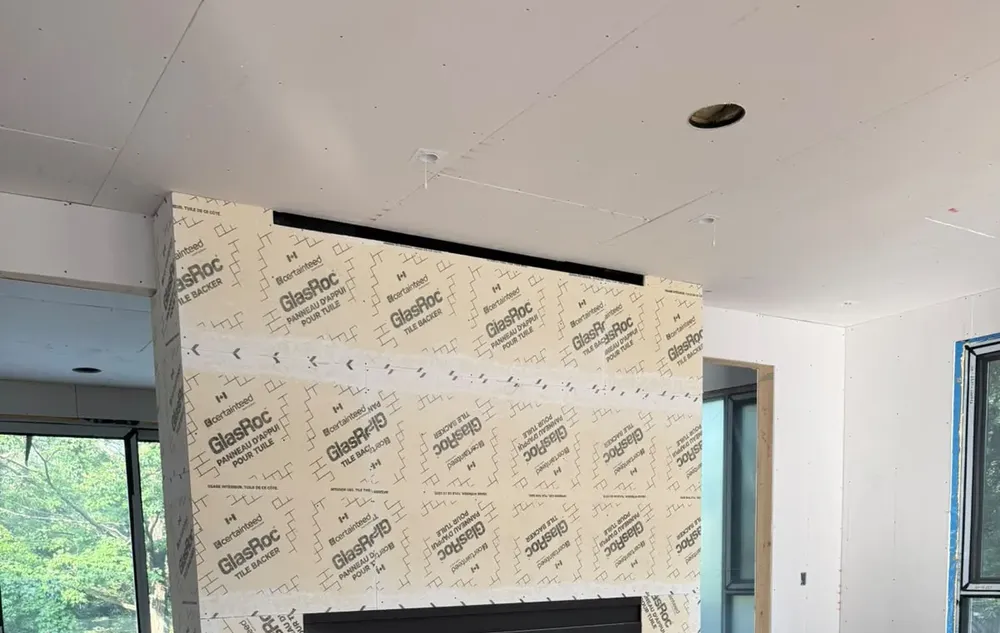
New board on one of our ceilings, before taping. One pot light housing is in, two more openings have their wires pulled through, and the joints are still bare. At this stage a light can still move without a patch.
A ceiling being flattened is open in a way it won't be again for years, so it's the easy moment to change what hangs from it. Decide these before the first coat goes on:
Pot lights: how many, where they sit, and which switch runs them. Our post on lighting a renovation in layers covers the spacing.
The ceiling fixture: whether it stays centred in the room or moves over a table that sits somewhere else now.
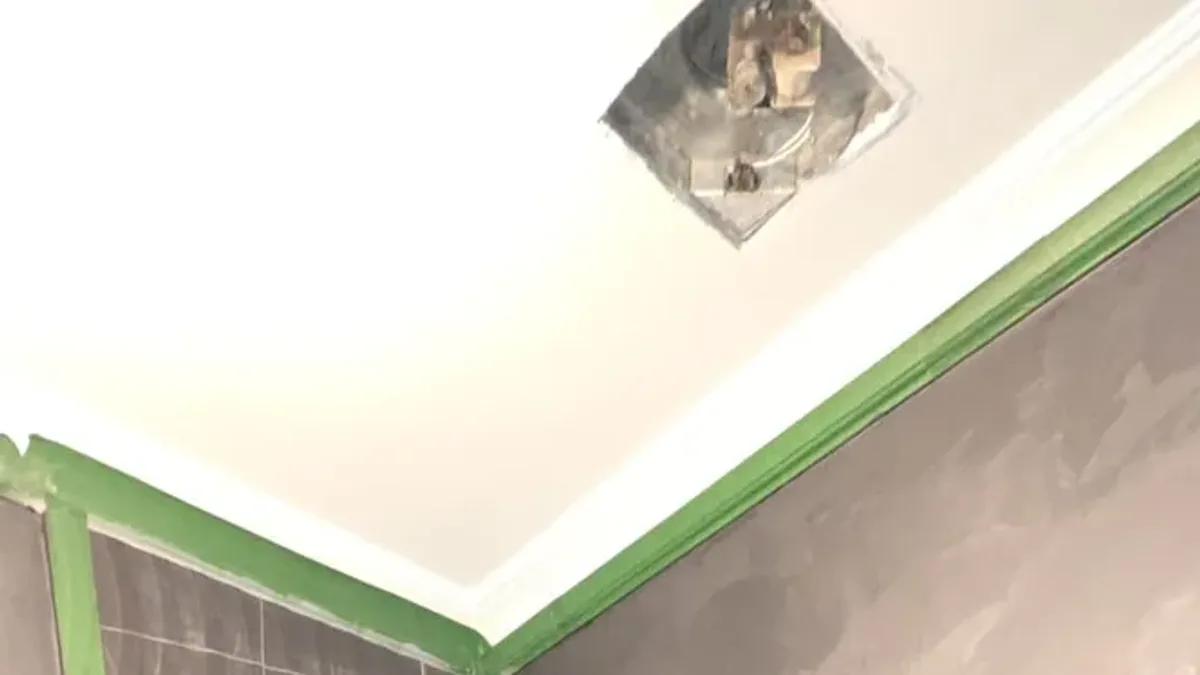
A bathroom fan that is loud or ends in the attic instead of outside. The ceiling around it is being redone anyway, and our guide to fan size and duct routes shows where the duct should go.
Smoke and carbon monoxide alarms, which come down for the work and have to go back up.
On the top floor, the attic: a light cut into an insulated ceiling needs a fixture made to sit in insulation and seal against air, or warm, damp air from the room leaks into the attic around it all winter.
The wiring is done by a licensed electrician while the ceiling is open, before any compound goes on.
How flat does the new ceiling need to be?
Flat enough for the light that will hit it. Light from straight below hides small waves. Light that runs along the surface, from a window near the ceiling, a lit cove or a row of lights close to a wall, shows every ridge, screw and joint.
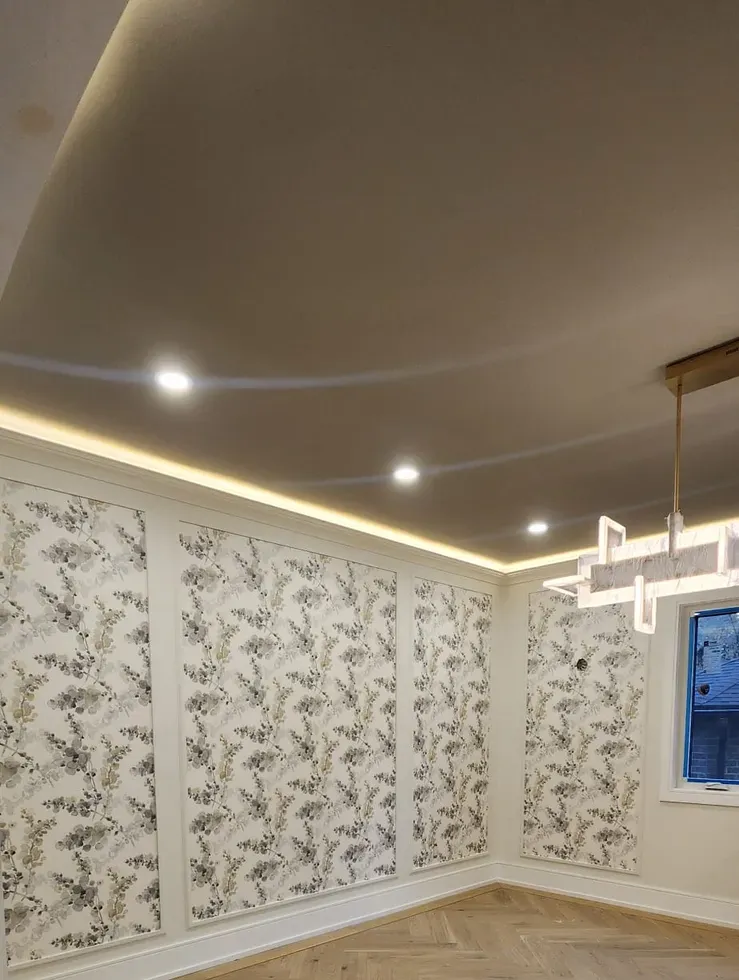
A dining room we finished. The cove sends light sideways across the whole ceiling, which is the case where a ceiling is finished to the highest level, with a thin coat over the entire surface and not only at the joints.
The finish levels on our drywall page set out which rooms need that last skim coat. You can check the result yourself with a flashlight:
Wait for the primer. Bare compound and board are two different shades, and the contrast hides the shape of the surface.
Darken the room: blinds closed, lights off.
Hold the flashlight against the ceiling near one wall, with the beam pointing across the surface rather than up at it.
Move it slowly along each wall in turn. A long shadow is a joint that needs another coat, a small ring is a screw head, and a soft dark patch is a low spot.
Mark each one with a short piece of painter's tape, never pencil, and walk the ceiling with your contractor before the finish paint goes on.
What should be settled before the room is emptied?
Most of the decisions above cost nothing to make early and a patch to change late. Have an answer for each of these before the furniture leaves.
Question
Why it changes the job
Has every ceiling that looks different been sampled, and do you have the report?
Without it, nobody should wet, scrape or sand the texture.
Is the texture painted? Dab a damp sponge on a corner: if the water beads and the texture stays hard, it is.
Paint takes scraping off the list in most rooms.
Which lights move, and which are new?
Holes are cut and wires pulled before the coats, not after them.
Is the crown moulding staying?
Skimming and new board both move the line where ceiling meets wall.
Is there an attic directly above?
Lights in an insulated ceiling need a different fixture.
In a condo, what does the building allow?
Noise hours, elevator bookings and the slab itself shape the plan, as our post on condo renovation rules explains.
Our part starts once the test is back clean, or once the specialist has finished: new board or a skim coat, finished to the level the room's light calls for, then primer and paint as part of our painting work. Send a photo of the ceiling and the year the house was built, and we can tell you which of the three routes it is likely to take.
Questions homeowners ask about this
Can I paint over a popcorn ceiling instead of removing it?
Paint can go over texture that is firmly stuck, but it seals the surface and makes any later scraping much harder. A loaded roller can also pull loose texture down, so in an older house have it tested before you paint.
How can I tell if my popcorn ceiling has asbestos in it?
Only a lab can tell. A professional takes small samples through the full depth of the texture and sends them for analysis. Colour, feel and age of the ceiling are clues at best.
Does covering a popcorn ceiling with drywall make the room lower?
Yes, by the thickness of the new board, usually about half an inch. The light and fan boxes also have to be brought forward to the new surface, and the crown moulding comes off and goes back.
Can a popcorn ceiling be skimmed without scraping it first?
Yes, when the texture is firmly bonded. It is the usual choice for painted texture and for texture sprayed on a concrete condo ceiling. Loose or flaking texture has to come off first, because wet compound pulls it away from the board.