
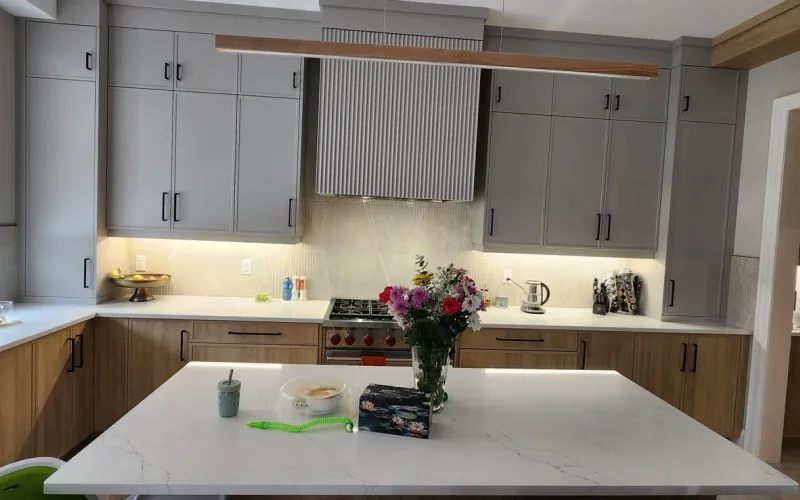
Kitchens
Cabinet Materials Compared: Plywood, MDF and Particleboard
Plywood, MDF or particleboard cabinet boxes for a Toronto kitchen: how each one holds screws, handles water and takes an edge, and where it belongs.
Read the guide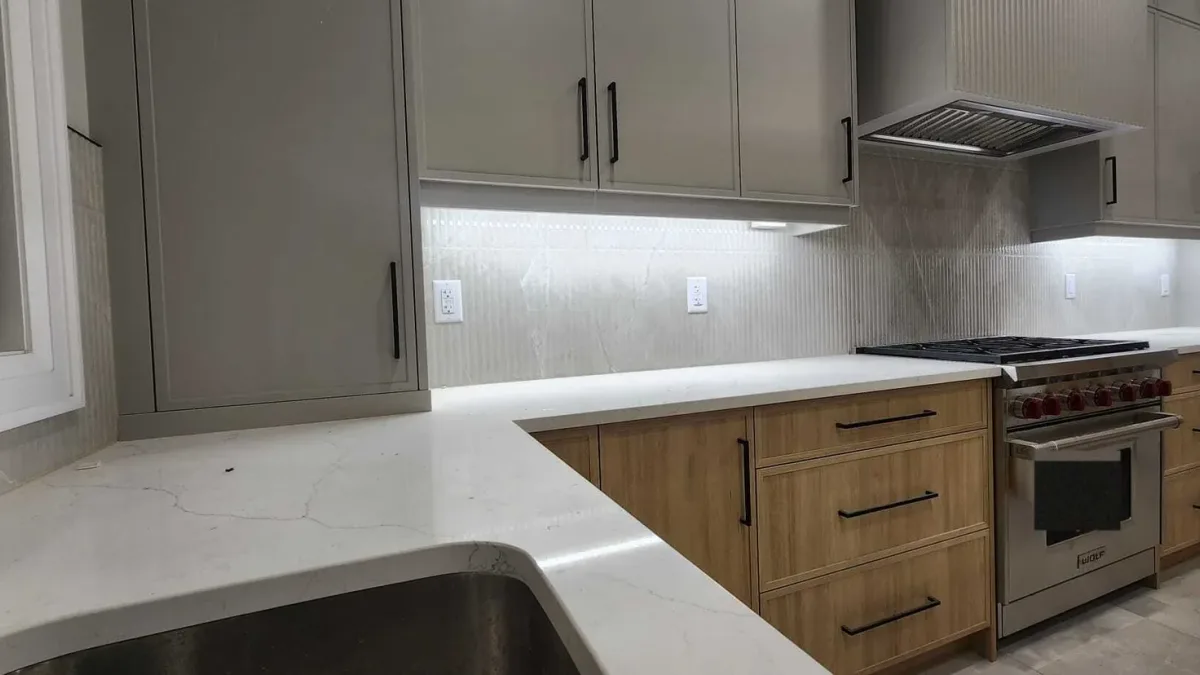
Quartz, granite, laminate or butcher block for a Toronto kitchen: how each handles heat, water, knives and stains, and what to settle before templating.
Kitchens · September 22, 2026 · 9 min read
The countertop is the one surface in a kitchen that gets touched, wiped, cut on, spilled on and leaned on every day, and it is usually chosen from a sample the size of a coaster. Countertop materials in most Toronto kitchens come down to four: quartz, granite, laminate and butcher block. Each one handles heat, water, knives and stains differently, and each one asks something different of the cabinets underneath it.
There is no best countertop, only a best one for a particular kitchen and a particular way of using it. A family that sets hot pots straight down from the stove needs something different from a household that wipes everything the moment it lands. Below is how the four materials actually behave, where each one fails, and what has to be settled before anyone cuts a slab.
Quartz is an engineered slab of crushed quartz bound with resin. Granite is natural stone cut from a quarry block. Laminate is a thin plastic-and-paper sheet glued over a particleboard or MDF core. Butcher block is strips of hardwood glued into a thick panel. Two are stone, one is a surface over a core, one is wood.
That last point decides more than appearance. Stone is heavy, rigid and indifferent to humidity, so it needs level, solid cabinets and does not care what the air is doing. Laminate is only as good as the board underneath it, so water at a seam matters more than anything on the surface. Wood moves with every seasonal change in humidity, so it has to be fastened in a way that lets it move. The table below sets the four side by side.
| Property | Quartz | Granite | Laminate | Butcher block |
|---|---|---|---|---|
| What it is | Crushed quartz bound with polymer resin and pigment | Natural stone, sawn from a quarry block and polished | Decorative layer over a particleboard or MDF core | Hardwood strips glued edge to edge |
| Needs sealing | No — the surface is not porous | Yes, periodically. How often depends on the stone | No | Yes — oiled, or finished with a film |
| Hot pans | The resin can scorch or discolour. Use a trivet | Tolerates heat well; a trivet still protects the sealer | Scorches and blisters | Scorches and leaves a dark ring |
| Knives | Resists scratching but dulls knives quickly | Resists scratching, dulls knives | Cuts through the surface layer | Marks easily, and the marks sand out |
| Standing water | Unaffected | Can darken until it dries if the sealer is worn | Swells the core at any seam or cutout | Stains and can blacken near a sink |
| Undermount sink | Yes | Yes | Usually a drop-in sink instead | Possible, but the edge takes constant water |
| Repair | Chips can be filled; a large crack cannot be hidden | Chips can be filled with coloured epoxy | Damage is usually permanent | Sands back and refinishes |
For most kitchens it is more predictable, not stronger. Quartz is consistent from slab to slab, needs no sealing and shrugs off wine, coffee and oil. Granite handles heat better and every slab is different. The deciding question is usually how you cook: quartz dislikes hot pans, granite dislikes being neglected.
Quartz earns its popularity through low maintenance. Because the resin fills every gap between the quartz particles, liquids have nowhere to go, and a daily wipe with mild soap and water is all it needs. The same resin is its weak point. A pan taken straight from a burner and set down can leave a pale or yellowed mark that does not clean off, and a surface in strong direct sunlight for years can shift in colour. That is also why quartz is an indoor material and not something for a barbecue counter.
Granite behaves the other way round. It formed from molten rock, so a hot pot does not worry it, and it holds up to a lot of daily abuse. But it is porous to a degree that varies from one stone to the next, and a worn sealer lets oil and wine soak in. A simple test tells you where you stand: leave a few drops of water on the surface for several minutes. If the stone darkens under them, it is time to reseal. And because it is natural, the sample you pick from is not the slab you get — always look at the actual slab before it is cut.
One thing worth knowing about quartz that has nothing to do with your kitchen: cutting engineered stone releases fine crystalline silica dust, which is a serious lung hazard for the people who fabricate it. Responsible fabricators cut and polish wet, in the shop. On site, cutting should be limited to what cannot be done in advance, and done with dust control. If an installer proposes dry-cutting a slab in your kitchen, that is worth questioning.
Laminate makes sense in a rental unit, a laundry room, a basement kitchenette, or any kitchen where the budget has to go into cabinets, layout and plumbing instead of the surface. Modern laminate looks far better than it did twenty years ago. Its limits are heat, knives, and water finding the core.
The surface itself is tough and easy to clean. The problem is that it is a thin skin over particleboard or MDF, and those cores behave exactly as described in our guide to cabinet materials: once water reaches an unsealed edge, the board swells and stays swollen. On a countertop, the places water reaches are predictable:
This is also why laminate usually gets a drop-in sink rather than an undermount one. With an undermount sink, the cut edge of the core sits directly above the bowl and gets wet every time the tap runs. A drop-in sink covers that edge with its own rim. There are systems made for undermounting under laminate, but they depend on sealing done perfectly, and a failure there means replacing the whole top.
It can work, but it is the hardest position a wood top can be put in. Wood around a sink needs a film finish rather than oil, a sealed cutout edge, and a household that wipes standing water. Butcher block is far more forgiving on an island, a baking station or a run away from the sink.
Two finishes are common, and they suit different uses. An oiled top, with a food-safe oil, can be cut on and repaired by sanding, but it needs re-oiling regularly and it does not keep water out for long. A film finish, a varnish-type coat, resists water much better but should not be cut on, because the knife breaks the film and water gets in through the cut. Oak adds a specific risk near a sink: its natural tannins react with water and iron, which leaves dark grey or black stains around the faucet and the sink edge that sanding does not always remove.
Wood also moves. Toronto homes go from humid summer air to very dry air once the heating starts in winter, and a wide wooden top grows and shrinks across its width with those swings. It has to be fixed to the cabinets with fasteners that allow that movement and finished on the underside as well as the top, or it cups, cracks, or pulls its fastenings loose. The upside is repairability. A scratched, stained or scorched butcher block can be sanded back and refinished, which no stone or laminate top can offer.
Both come up often enough to mention. Marble is beautiful and soft: lemon juice, vinegar and tomato etch dull spots into its polish that no sealer prevents. Porcelain slab is very hard, heat-resistant and non-porous, with the pattern printed on the surface, so edge profiles and chips need more care in fabrication and use.
Marble suits people who are comfortable with a surface that visibly ages — the etch marks are part of how it looks after a few years. Porcelain slab is increasingly used for counters, backsplashes and even full feature walls, because one slab can run from counter to ceiling with the same veining, which ties in with how we plan tile and backsplash installation. Its hardness makes it demanding to cut and edge, so the fabricator's experience with it matters more than it does with quartz.
Stone and solid tops are measured from the installed cabinets, not from drawings. The base cabinets must be in, level and fixed, and the sink, faucet and cooktop models chosen, before the fabricator makes a template. Anything that changes after templating usually means a new slab.
This is the step that most often stretches a kitchen schedule, because there is a fabrication gap between templating and installation and the kitchen sits without a working sink in the meantime. We cover where it falls in the sequence in what a kitchen renovation involves, week by week. The practical checklist below is what we work through with a homeowner so that nothing forces a second template:
Match the material to the room's water, heat and wear, and to the people using it. Busy family kitchens do well with quartz. Serious cooks who put pans down hot often prefer granite. Rentals and laundry rooms suit laminate. Butcher block works best as an island or a second surface rather than the main run.
| Situation | Material that usually fits | Why |
|---|---|---|
| Busy family kitchen, little time for maintenance | Quartz | No sealing, stain-resistant, consistent colour — as long as trivets are used |
| Cooking-heavy household, pans set down hot | Granite | Handles heat far better than resin-bound quartz; resealing is the trade-off |
| Rental unit or basement suite | Laminate with a drop-in sink | Keeps the investment in cabinets, plumbing and layout; replaceable later |
| Island or baking station away from the sink | Butcher block, or quartz with a wood section | Warmth and a surface you can repair, without constant water exposure |
| Bathroom vanity | Quartz or a solid-surface top | Constant humidity and splashing; see how we handle it on bathroom renovations |
| Laundry room | Laminate or quartz | Folding surface that tolerates detergent spills; water near the washer matters most |
| Condominium suite | Quartz or porcelain slab, planned around the elevator | Slab length is limited by what fits in the elevator and corridor, which can force a seam |
That last row is a real constraint. In a condo, a long slab that fits the kitchen may not fit the service elevator, so seams are planned around the building rather than the room, alongside the other rules in what a condo board will and will not allow.
Whatever you choose, get the material, thickness, edge profile, sink type and seam locations written into the quote, the same way a good contractor quote spells out everything else. If you are planning a kitchen renovation in Toronto or the GTA, finished kitchens are in the project gallery, and you can get in touch to talk through which surface fits the way you use your kitchen.
Neither is better across the board. Quartz is non-porous, needs no sealing and resists stains, which suits busy households, but its resin binder can scorch or discolour under a pan taken straight from the burner. Granite tolerates heat much better and every slab is unique, but it is porous and needs resealing periodically. If you set pans down hot, granite is more forgiving; if you want minimal maintenance and use trivets, quartz is the easier choice.
Usually laminate gets a drop-in sink instead. Laminate is a thin surface over a particleboard or MDF core, and with an undermount sink the cut edge of that core sits directly above the bowl and gets wet every time the tap runs. Once water reaches the core, it swells permanently. Undermount systems for laminate exist, but they depend on flawless sealing, and a failure means replacing the whole top. A drop-in sink covers the cut edge with its own rim.
Leave a few drops of water on the surface for several minutes. If the stone darkens under the drops, the sealer is worn and water is soaking in, so it is time to reseal. If the water beads and the stone stays the same colour, the sealer is still working. How often granite needs resealing varies from one stone to another, which is why the water test is more reliable than a fixed schedule.
Stone and quartz countertops are templated after the base cabinets are installed, fastened and level, not from the drawings. The sink, faucet and cooktop models also need to be confirmed first, because the fabricator cuts to them. There is then a fabrication gap before installation, during which the kitchen has no working sink. Any change to the layout or sink after templating usually means a new slab, so those decisions come first.
Kitchens
Plywood, MDF or particleboard cabinet boxes for a Toronto kitchen: how each one holds screws, handles water and takes an edge, and where it belongs.
Read the guide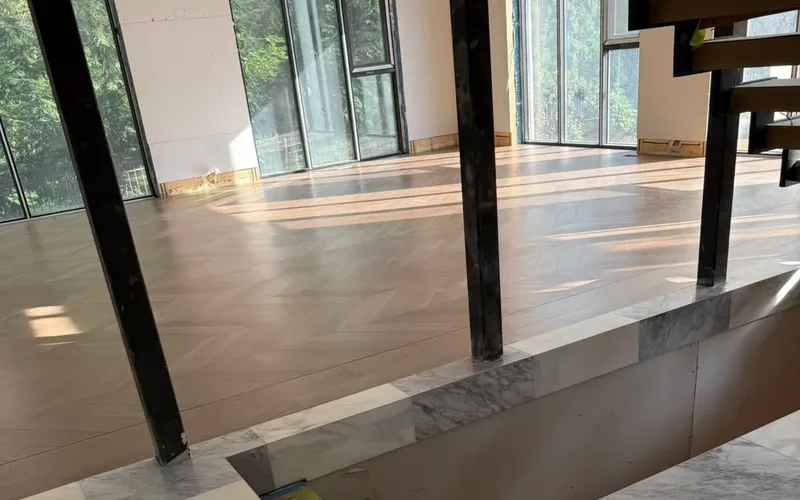
Structure
How to tell if a wall is load-bearing before a Toronto renovation: joist direction, the bearing line, who decides, permits and what replaces the wall.
Read the guide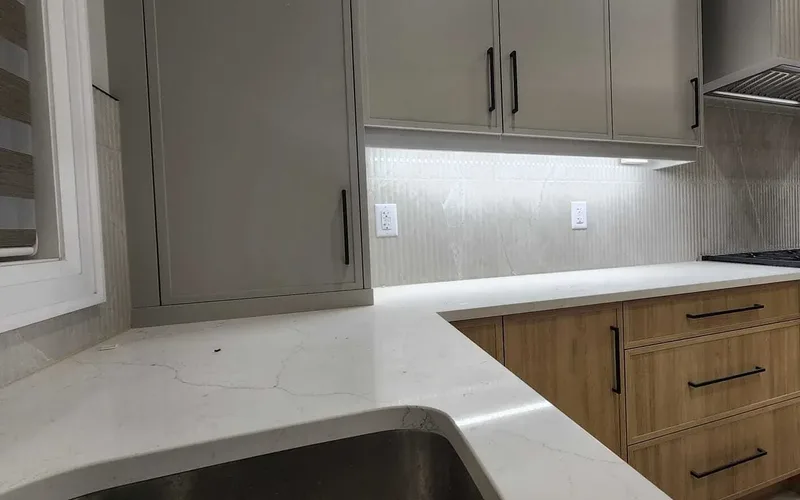
Condos
Condo renovation rules decide what you may change in a Toronto suite: what the board owns, when an alteration agreement is needed, and what gets refused.
Read the guide
We will walk the space with you, tell you what it actually takes, and put it in writing.